

Two of my quilts, Spider Web and Bow Tie, have been donated to the Newark Museum.
Read More"What's on the back?" in Quiltmania
I am thrilled to share that Quiltmania has featured my article, "What's on the back?" in its January/February 2016 issue. The two spreads are beautifully laid out and include the front and back pairs of some of my favorites.
Read MoreBritish Patchwork & Quilting reviews Unconventional & Unexpected alongside Losing the Compass
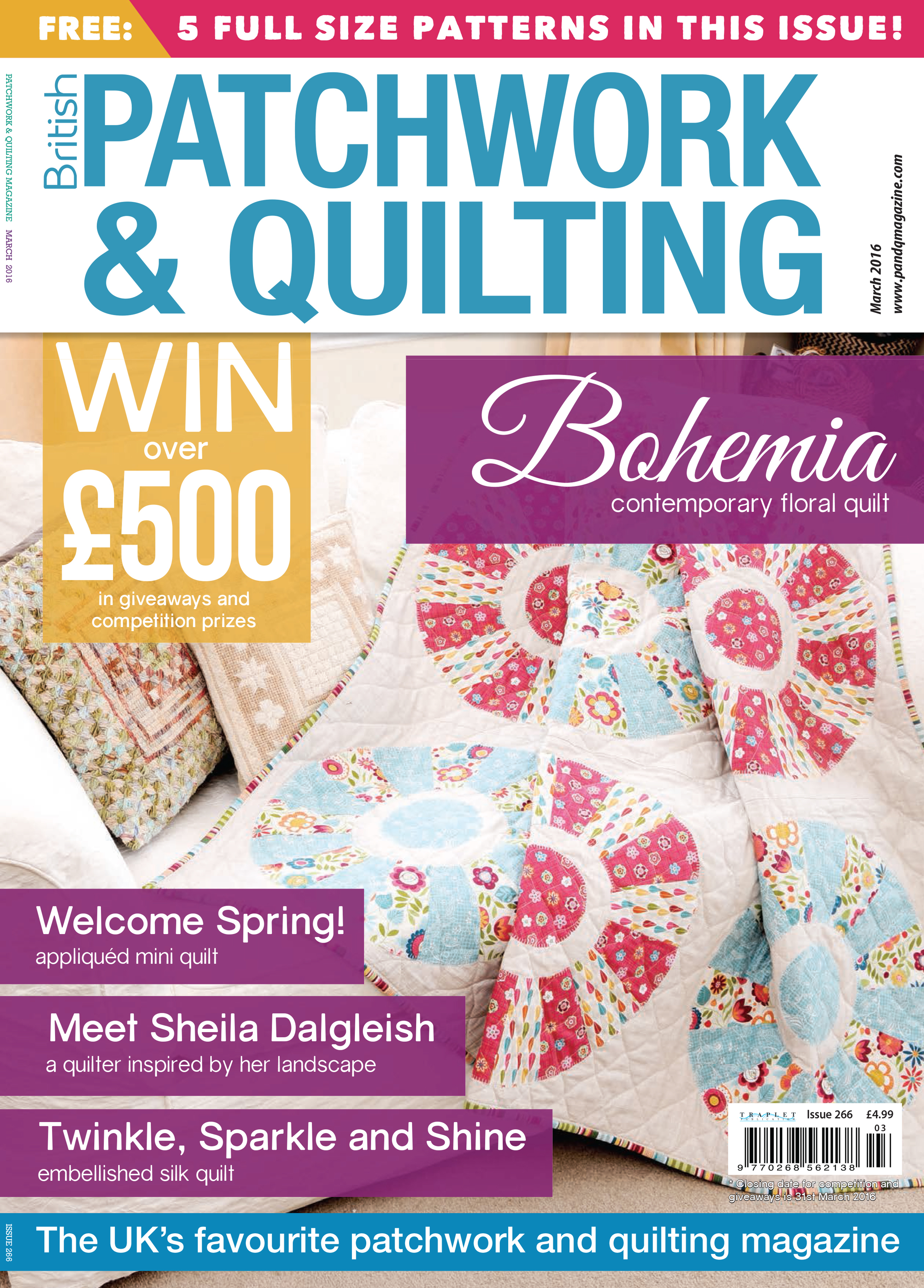
I am thrilled that Deborah Nash of British Patchwork & Quilting writes about my publication, Unconventional & Unexpected, alongside the exhibition Losing the Compass.
Ms. Nash picks up on many of the beautiful motifs I love about both quilts and the pieces in the exhibition at White Cube, noticing the relationships between accident and chaos with structure. She sees the distortions in the Boetti embroidered pieces amidst the stringent grid; she sees the "wobble" of the quilts' edges in Unconventional & Unexpected. Here are artists and quiltmakers willing to see what happens when you venture outside the grid. Personality happens. All the while Ms. Nash recognizes the need for context and conversations around all of these pieces and how publications and exhibitions can act as a bridge between the fine art and the textile/craft communities. She speaks about the artworks and the quilts in the same language.
Featured are images from the exhibition, as well as quilts from my collection. I am pleased that she chose to feature the brilliantly orange Nine Patch, Virgie Walton's Stripes, Original Design of work clothes, 8 which is included above, and a Log Cabin, variation.
A huge thank you to Ms. Nash and everyone across the pond at British Patchwork & Quilting!
Read "Losing the Compass: Unconventional and Unexpected" in the March 2016 issue of British Patchwork & Quilting.
“What I like is its mystery. The square and oblong patches vary in size and number, though not so much that the surface becomes a chaotic jumble. It has an order, but the order changes; sometimes there are six patches in a row, sometimes seven. It ought not to work, but it does. The squares of primary yellow, blue, pale pinks and off-whites are gridded by machine; on top are smaller patterned or coloured squares and then in most, but not all, there’s a wiry motif of a figure eight stitched in dark cotton thread, sometimes looking like a wisp of hair. What does this motif mean? Is it an infinity symbol and not a figure eight at all? There’s a talismanic quality to this quilt that makes me wonder what it would be like to sleep beneath it, what dreams I might have.”


Losing the Compass | Quilts at White Cube, London
I am pleased to share that two of my quilts are part of the exhibition, Losing the Compass, at White Cube's Mason's Yard space.
Read MoreFound/Made exhibition featured in Hi-Fructose

I am delighted to share that Hi-Fructose has done a feature on the upcoming exhibition Found/Made at the San Jose Museum of Quilts & Textiles. Hi-Fructose highlights the work done by contemporary art and quiltmakers in the exhibition such as Joe Cunningham, Sabrina Gschwandtner, Luke Haynes, Clay Lohmann, Therese May, Sarah Nishiura, and Ben Venom. I'm excited to see their work together with others in July.
Read the article in Hi-Fructose.
Found/Made will be at the San Jose Museum of Quilts & Textiles from July 11 to November 1, 2015.


Sonoma Index-Tribune asks Kiracofe "why he finds such comfort in his vast collection of comforters"


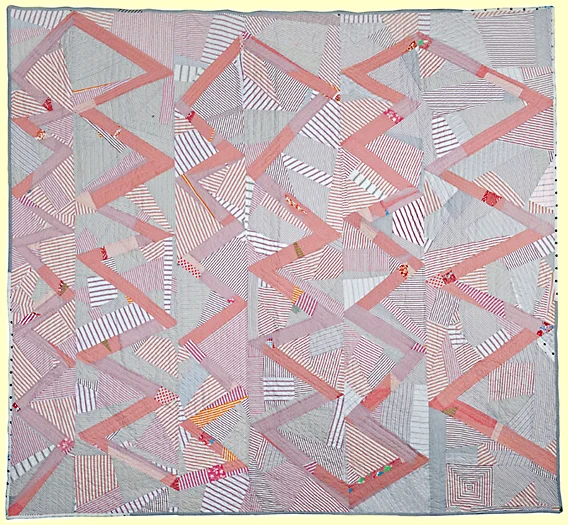
Renowned quilt authority and collector Roderick Kiracofe hangs some quilts Wednesday as part of an exhibit at the Sonoma Valley Museum of Art. Image: Robbi Pengelly of Sonoma Index-Tribune.
The exhibition also titled Unconventional & Unexpected is finally up at the Sonoma Valley Museum of Art. The Sonoma Index-Tribune did a beautiful piece on the exhibition. They came with great questions.
Read more in the Sonoma Index-Tribune.
U&U is being exhibited simultaneously with Shaker Stories from the Collection of Benjamin H. Rose III. The Sonma Index-Tribune put together a beautiful gallery of images from both exhibitions.
“Why quilts?”
“How would 1950s and ’60s homemakers be so influenced by the modern art movement? I don’t recall June Cleaver hanging many Neo-Dadaist pieces in the living room.”
“How do the uses of color and pattern play out in this ‘below the radar’ modern art?”
Unconventional & Unexpected, the exhibition, runs from February 14 until May 17, 2015 at the Sonoma Valley Museum of Art.
"Some of these quilts did not even have straight sides!"


My quilts and words were featured amidst this conversation, "Reassessing the Revival," about the quilt revival in Antiques and The Arts Weekly. Here is an excerpt from Kate Eagen Johnson's depth article:
“Unconventional & Unexpected is dedicated to quilts of more recent vintage. About ten years ago, long-time quilt dealer Kiracofe literally woke up one day and thought ‘What were the ‘everyday quilts’ made from the 1950s to the end of the Twentieth Century like? And where they even made?’ He had ended his historical survey The American Quilt, 1993, with quilts from the 1940s because quilt dogma held that no good quilts were made after 1950.
Kiracofe began checking out quilts of a more recent vintage. Many, of course, were traditional in style and technique, but there were also ‘maverick’ quilts whose makers reveled in breaking the rules and in improvisation. The latter were the ones that appealed to him and he began buying them on eBay and through other means. Perhaps to the chagrin of Arts and Crafts purists, the makers of these objects did not always fashion quality, natural materials by hand. Many unabashedly delighted in polyester and rayon that they ornamented via machine stitching and appliqué. Some of these quilts did not even have straight sides!”
Janneken Smucker weighs in
“I had the pleasure of interviewing Roderick for my research for Amish Quilts: Crafting an American Icon about his role as a quilt dealer in the 1980s. Although Kiracofe and Kile did not specialize in Amish quilts, they bought and sold many of them, and convinced corporate buyers of their significance. In fact, the first substantial article I read about the Esprit Amish quilt collection was by Michael Kile, published in the 1983 Quilt Digest. The accompanying images of Esprit’s corporate headquarters filled with Amish quilts helped me build my argument about Esprit’s vital role in the promotion of quilts as art objects.”

Janneken and I at AQSG Seminar 2014, Milwaukee. Image courtesy of janneken.org.
I was so pleased when my friend and colleague Janneken Smucker agreed to write the "quilt history" essay for the book. She is doing an amazing job as part of the next generation of quilt historians. I have always enjoyed following her writing and projects. Be sure to include her newest book, Amish Quilts: Crafting an American Icon, in your quilt library.
Her blog post about Unconventional & Unexpected really captures what I hope people take away from U&U as she concludes: "I hope you join me in looking, reading, and thinking, and then behold these quilts as completely unexpected, yet just what you’ve been looking for."
Read her blog post here.